The Best Parts of the 2014 Film “Maps to the Stars”
Maps to the Stars, written by Bruce Wagner and directed by the one and only David Cronenberg, is campy, deranged, devastating, and poetic (the interconnectedness, the themes, the motifs, the symbols, etc.).
It feels like a cult classic, thanks to its transgressive nature and my obsession with it. But there is no cult. It simply exists in the background, neither despised nor revered by its watchers. Such is its fate: to be slowly forgotten, lost to the traces of time. So… I’m here to shine a light on it by exploring some standout scenes and breaking them down to make them more understandable.
1. The iPad Scene
“We did $780 million worldwide. People don’t realize that. Don’t you have an iPad?”
Benjie Weiss, child star of “Bad Babysitter” and recovering drug addict, pays a fan (Cammy) a visit in the hospital as part of a public relations strategy. He appears to lack even a modicum of empathy or self-awareness here.
The interaction is dry, awkward, and darkly funny. Benjie has the audacity to ask Cammy how she got AIDS, which is an insensitive question made worse by the fact that she has non-Hodgkin’s lymphoma, not AIDS.
After Cammy passes, however, this moment does come back to haunt him in the form of hallucinations. We’ll talk more about Benjie’s short-lived journey in Maps to the Stars further below.
2. The Sarah Gadon Scenes
“You want that role, but you’re not gonna get it. You don’t even have the chops!”
Sarah Gadon does a phenomenal job playing Clarice Taggart, mother of Havana Segrand and a glamorous Hollywood actress who died in a fire in the mid-70s.
Having been physically and sexually abused by Clarice, Havana suffers from childhood trauma and is unable to escape the clutches of her mother, whom she frequently hallucinates. That bathtub scene above is one of many such hallucinations.
Perhaps in an unconscious effort to exert some form of control over her traumatic memories and cling to the remnants of her fame at the same time, Havana is determined to play her mother in a remake of a film called Stolen Waters. The video below shows two of the scenes in Stolen Waters.
“You don’t think I set those fires, do you?”
You can see Havana, who is aging and losing her relevance in Hollywood, sitting transfixed, watching Clarice, who is remembered as a timeless beauty (because she died young) — forever untouched and frozen in a time capsule.
That pristine elegance and delicateness Clarice appears to possess — the sort that you can only dream of emulating in your life — is frighteningly contradictory to the reign of terror and control she has over Havana. Such is Sarah Gadon; even when she spews the most vile words and plays a character with a heart as black as coal, you can’t help but stare at her in rapture.
Sarah is captivating in the film Antiviral as well, directed by Brandon Cronenberg (David Cronenberg’s son!).
3. The Depravity in General
The depravity of humans is on full display in Maps to the Stars. Let’s explore three moments that leave a rather strong impression.
The Off-Putting Dancing Scene
“This is for little Micah! Little miracles!”
Upon hearing that she would have the chance to play her mother in the remake of Stolen Waters because the original actress’ young son (Micah) died in an accident, Havana prances around the yard and gets her personal assistant (Agatha Weiss) to share in her joy.
Around others, Havana is seen feigning concern for the actress. She also expresses hesitance and doubt about whether she should replace the actress’ role in the remake. However, around Agatha, who is completely unaware of the gravity of the situation, Havana does not bother to rein in her celebratory mood — singing, clapping her hands, and dancing about with a childlike charm. It’s both a morbidly amusing and deeply unsettling scene which shows her devoid of empathy and quite the epitome of evil.
It’s hard not to feel sympathy for Agatha. She has to put up with Havana’s volatile mood swings. Only when Havana is jubilant does she finally get some reprieve. In fact, Agatha seems to be earnestly delighted that Havana is happy and does not further question the source of her happiness.
A Sticky Situation: Benjie Gets in Trouble
“The world will know we have done crimes.”
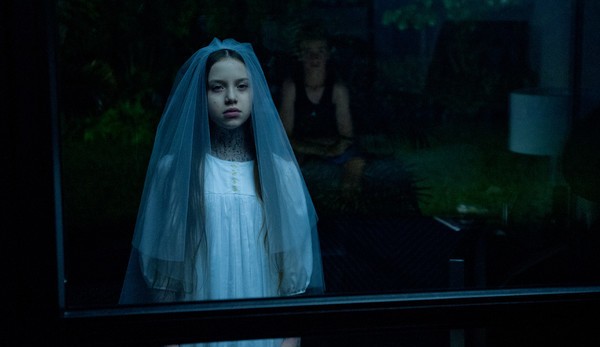
Benjie is on a downward spiral. He relapses, recklessly swings a gun around and kills his friend’s dog, and then proceeds to strangle his younger co-star (Roy), whom he hallucinates as being Cammy. On a side note, this image of Cammy with Benjie’s reflection in the background is stunning.
Cristina Weiss, Benjie’s mother who also manages his career, tries her best to downplay the severity of him nearly taking Roy’s life (“He hurt one boy! One boy!”) . And when Stafford Weiss, Benjie’s father, says that Roy survived, both Cristina and Stafford are more relieved at what that means for Benjie.
It’s clear that Benjie’s parents are disgustingly selfish. They are much more concerned with their image and reputation at the expense of their son’s mental health and destructive behavior. To them, he is merely a cash cow to be maintained.
The End of Havana
“Do you… do you think that Carrie Fisher… Do you… do you think Nicole Kidman and Halle Berry have scary little animals working for them? Scary, deformed…”
Agatha is also on a downward spiral. The movie begins with her arriving in Los Angeles, desperate to make amends with her family after setting a fire and nearly killing them. At first, things seem to be looking up: Agatha is hired by Havana as her personal assistant and forms a connection with Jerome, a limousine driver and struggling actor. But things progressively get worse soon enough.
First off, she was shut off by her family since the catastrophic fire, so it’s no surprise when her father, Stafford, promptly tells her to leave Los Angeles upon hearing about her presence. Next, she catches Havana and Jerome being blatantly intimate in the back of a car and is then immediately personally attacked and ruthlessly berated by Havana for her work performance.
It’s this series of events that ultimately brings Agatha to a breaking point. Agatha’s catharsis can be felt through the screen, as you watch her slam Havana over and over in the head with Havana’s own award. Murder is wrong, but there is relief in seeing Agatha retaliate and Havana’s tyranny and self-obsession come to an end.
4. A Family Broken Beyond Repair
To say that the Weiss family is deeply traumatized and dysfunctional would be an understatement. Cue Stafford falling asleep to his own motivational speech playing on TV, pan to Cristina bursting into uncontrollable, distressed sobs in the bathtub, and then cut to Benjie sitting despondently playing video games, perturbed by his mother’s cries. It’s a short but effective scene.
5. The Literal and Figurative Incest
“We didn’t know we were brother and sister.”
To the shock of no one, it is revealed that Stafford and Cristina are siblings, another dark secret that they are bent on keeping hidden from the rest of the world.
There are three literal instances of incest in Maps to the Stars: Havana was sexually abused by her mother, Stafford and Cristina are siblings, and Agatha and Benjie are children of incest. And to tie it all up in a bow, at the end of the film, Agatha and Benjie steal their parents’ rings to carry out a wedding ritual they used to perform as kids. This is the kind of thing you do only when generational trauma is embedded in your DNA.
“I had 13 summers. Not so bad.”
On a broader level, Hollywood is infamous for being an incestuous cesspool, an inbreeding playground rife with nepotism, where everyone knows everyone, in one way or another, and everyone gets with everyone.
6. The Purposefully Bad CGI Flames
Fire is a big thing that connects all the lead characters in Maps to the Stars. Here are the key moments where it is mentioned:
- Agatha set fire to her family’s home. This incident is one which the Weiss family, particularly Stafford, vehemently tries to bury and leave behind. Stafford’s rejection of her contributes to the entire family’s demise.
- Havana’s mother, Clarice, died young in a fire. Her image at that age is preserved and is one which Havana is fixated on and constantly trying to live up to.
- “Fire and water! We’re fire and [Micah’s] water!” Havana exclaims at Agatha after finding out that Micah (son of the actress rivalling her for the role in the remake of Stolen Waters) had drowned.
- Clarice played a mental patient who sets fires (Rebecca) in Stolen Waters. Like Havana, Agatha (reminiscent of Rebecca) is equally mesmerized by the film. She gets a bemused Jerome to reenact a scene from it with her.
- Finally, Cristina opts for self-immolation. The CGI flames are laughably bad for a movie released in 2014, to the point where you know it had to be an intentional choice. Perhaps they are meant to mock the artificiality of Hollywood and how it engulfs those who pursue validation and fame at any cost.
7. The Poem That’s Repeatedly Quoted Throughout the Entire Film
This beautiful poem is Liberté by Paul Éluard. By the time you finish the show, you feel inclined to look up the poem, memorize it, and then recite it until it consumes you, just like it consumes the characters in the show.
The video below compiles the moments where the characters quote the poem.
What unites these moments is the genuine expression of real emotions. Let’s delve a little deeper into each moment.
The hallucinatory figure of Cammy, likely a manifestation of Benjie’s guilty conscience, articulates a few lines from the poem. It gives her a voice, which is an expression of his buried, unresolved feelings. In another scene, Benjie has the poem hidden in between the pages of his father’s best-selling book, Secrets Kill (an ironic title for a man with many secrets). It’s this side of Benjie that is most endearing, a stark contrast to his usual uncouth behavior. Here, you are able to feel his wish for autonomy and release from his authoritarian circumstances. That is, until a knock on the door breaks his reverie.
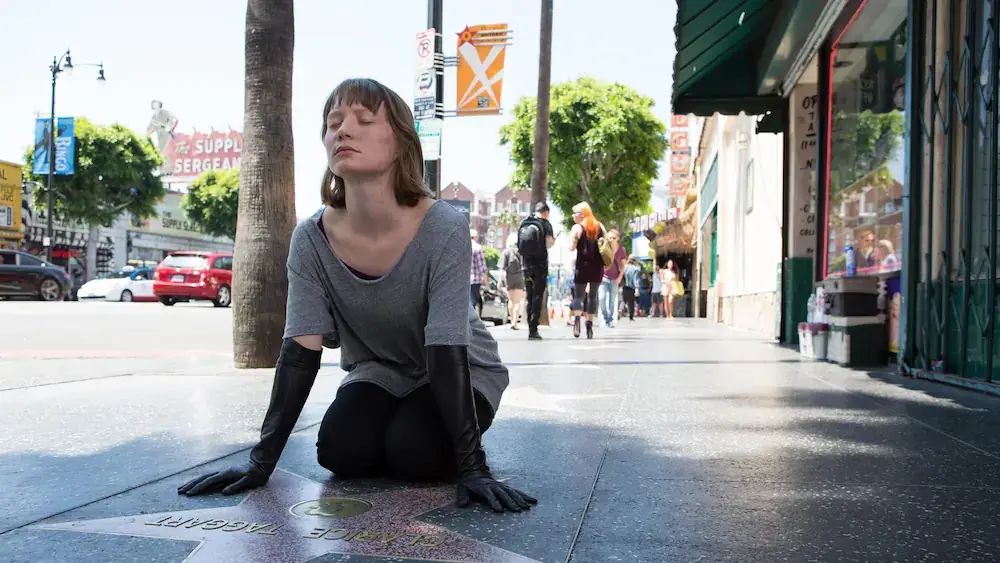
In Stolen Waters, Rebecca quotes the poem to her lover in a show of desire and love. Feeling spiritually connected to Rebecca/Clarice, Agatha passionately quotes it whilst kneeling down and touching Clarice’s star on the Hollywood Walk of Fame. Agatha also reenacts the scene from Stolen Waters with Jerome (who appears to be sincere enough but is actually using his romance with her for “research” purposes, i.e. for script material).
In a ritualistic manner, Agatha recites the poem and takes her pills. It’s a routine that keeps her grounded. Later, however, Agatha throws away her pills after her father demands that she “take [her] skin cream and [her] meds and [her] hefty bag luggage” and leave Los Angeles. She utters a single “liberty” after doing so. Interpreted simply, it is an act of defiance and an attempt to be freed from the shackles of medication dependency and the confines of body and mind.
In the final scene, Agatha and Benjie recite the end of the poem as they lay dying at the site of their family’s former home. The film aptly concludes with one last “liberty” before the screen fades to a blanket of stars. It is this moment of death where they feel the most liberated.